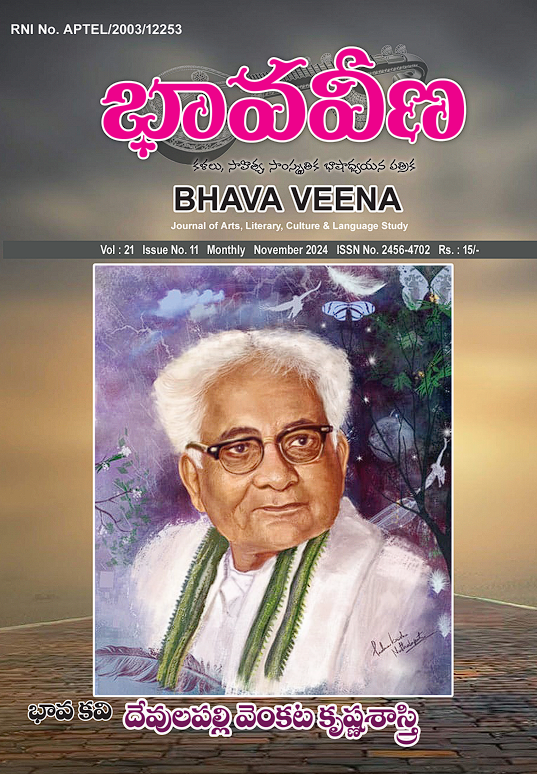
This Executive Summary provides an overview of the November 2024 edition of Bhava Veena, a monthly Telugu journal dedicated to arts, literature, culture, and language studies.
Overview
The November 2024 issue (Vol. 21, Issue 11) is a commemorative edition featuring the renowned "Bhava Kavi" Devulapalli Venkata Krishna Sastri on its cover. The journal, edited by Dr. Pitta Santhi and Dr. Payarda Nagaiah, serves as a platform for academic research and literary analysis, featuring contributions from various scholars across Southern India.
Key Features & Content
1. Tribute to Devulapalli Venkata Krishna Sastri
The editorial highlights the life and legacy of the celebrated poet. It traces his journey from Pithapuram to becoming a legendary figure in Telugu cinema and literature, noting his unique ability to give "poetic dignity" to film songs and his role as a representative of the Bhava Kavithwam movement.
2. Literary and Social Analysis
The edition contains several research-oriented articles covering a wide array of topics:
Social Reflection in Proverbs: An analysis of how Telugu proverbs mirror the social and cultural life of the people.
Classical & Modern Poetry: Discussions on the works of Praja Kavi Kaloji and the social significance of Sataka literature (such as Sumati and Vemana Satakas).
Folk Medicine: An exploration of traditional healing practices and "Natu Vaidyam" used by rural Telugu communities.
Communist Ideology in Theatre: A study of the play "Vijayam Manade" and its portrayal of labor struggles and social reform.
Women in Literature: A profile on the diverse creative styles of writer Sujana Devi.
3. Academic Recognition
The issue documents the Dr. A.P.J. Abdul Kalam National Merit Awards ceremony organized by the Southern Private Lecturers Teachers Organisation (SPLTO). It features several scholars and professors from universities like Andhra University, Osmania College, and Kakatiya University being honored for their contributions to education.
Core Themes
Cultural Preservation: Deep dives into folk wisdom, traditional medicine, and linguistic heritage.
Social Reform: Analysis of literature that challenges caste discrimination, promotes humanism, and advocates for the marginalized.
Literary Criticism: Academic evaluation of both classical Satakas and modern revolutionary poetry.
Note: The journal maintains a standard disclaimer that the views expressed by the authors are their own and do not necessarily reflect the opinions of the editorial board.