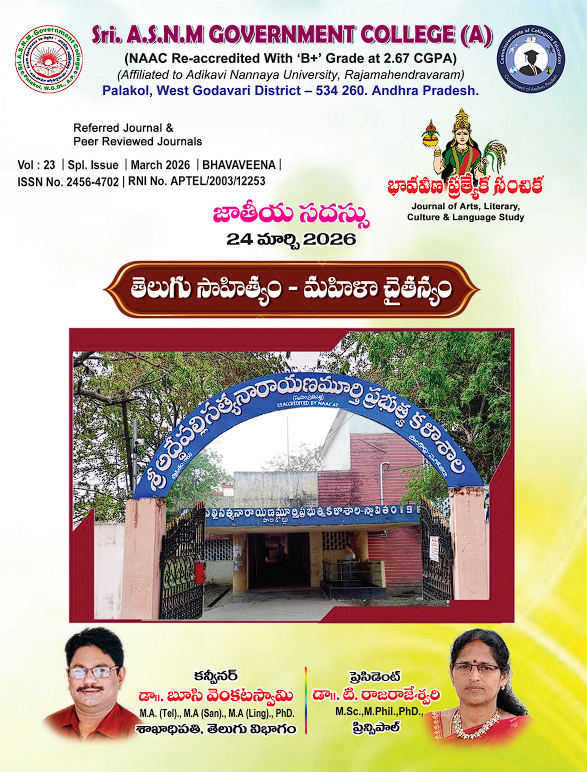
జాతీయ సదస్సు 24 మార్చి 2026 తెలుగు సాహిత్యం - మహిళా చైతన్యం
వ్యాస రచయిత (Author)
భావవీణ
సారాంశం (Abstract)
This document is a special edition of the journal Bhavaveena (Volume 23, March 2026), titled "Telugu Literature - Women's Consciousness" (తెలుగు సాహిత్యం - మహిళా చైతన్యం). It serves as a comprehensive souvenir for a National Seminar held on March 24, 2026, organized by the Department of Telugu at Sri A.S.N.M. Government College (A) in Palakol, Andhra Pradesh.
Core Objective
The document explores the evolution of women's identity, rights, and empowerment as reflected in Telugu literature across different eras—from ancient scriptures and classical poetry to modern feminist and Dalit movements.
Key Themes and Insights
The journal features messages from educational leaders and academic papers from various scholars. The content is broadly categorized into the following themes:
Historical Evolution: * Ancient & Medieval: Analyzes the status of women in the Vedas and Puranas, noting the shift from respected figures to the limitations imposed by patriarchal systems. It highlights early voices like Tallapaka Timmakka and Molla.
Reform Era: Credits social reformers like Kandukuri Veeresalingam and Gurajada Apparao (notably his play Kanyasulkam) for initiating public discourse on women's education and child marriage.
Feminist Movements (1980s-90s): * Discusses the "Neeli Meghalu" (Blue Clouds) era, where women began writing about their own bodies, labor, and domestic struggles.
Key authors mentioned include Olga, P. Satyavathi, and Jayaprabha.
Diverse Perspectives:
Dalit Women's Consciousness: A significant portion is dedicated to how Dalit women face "double oppression" (caste and gender). Authors like Jupaka Subhadra and Gogu Shyamala are featured for their resistance literature.
Tribal/Banjara Voices: Includes a study on the first Banjara historical novel, Poryatara, focusing on the heroism of Heeribai.
Social Critiques: * Articles examine the "invisible labor" of housewives, the politics of the "veil" (pyta), and the objectification of women in classical poetry.
Major Contributors & Editorial Team
Seminar Convener: Dr. Busi Venkataswamy (Head, Dept. of Telugu).
College Principal: Dr. T. Rajarajeshwari.
Key Academic Voices: Prof. Darla Venkateswara Rao (University of Hyderabad) and Prof. Vistali Sankara Rao (University of Madras), who provided the keynote perspectives on the transition from "Silence to Slogan."